

The new book by Guillermo Söhnlein
Titan Unfinished: An Untold Story of Exploration, Innovation, and the OceanGate Tragedy
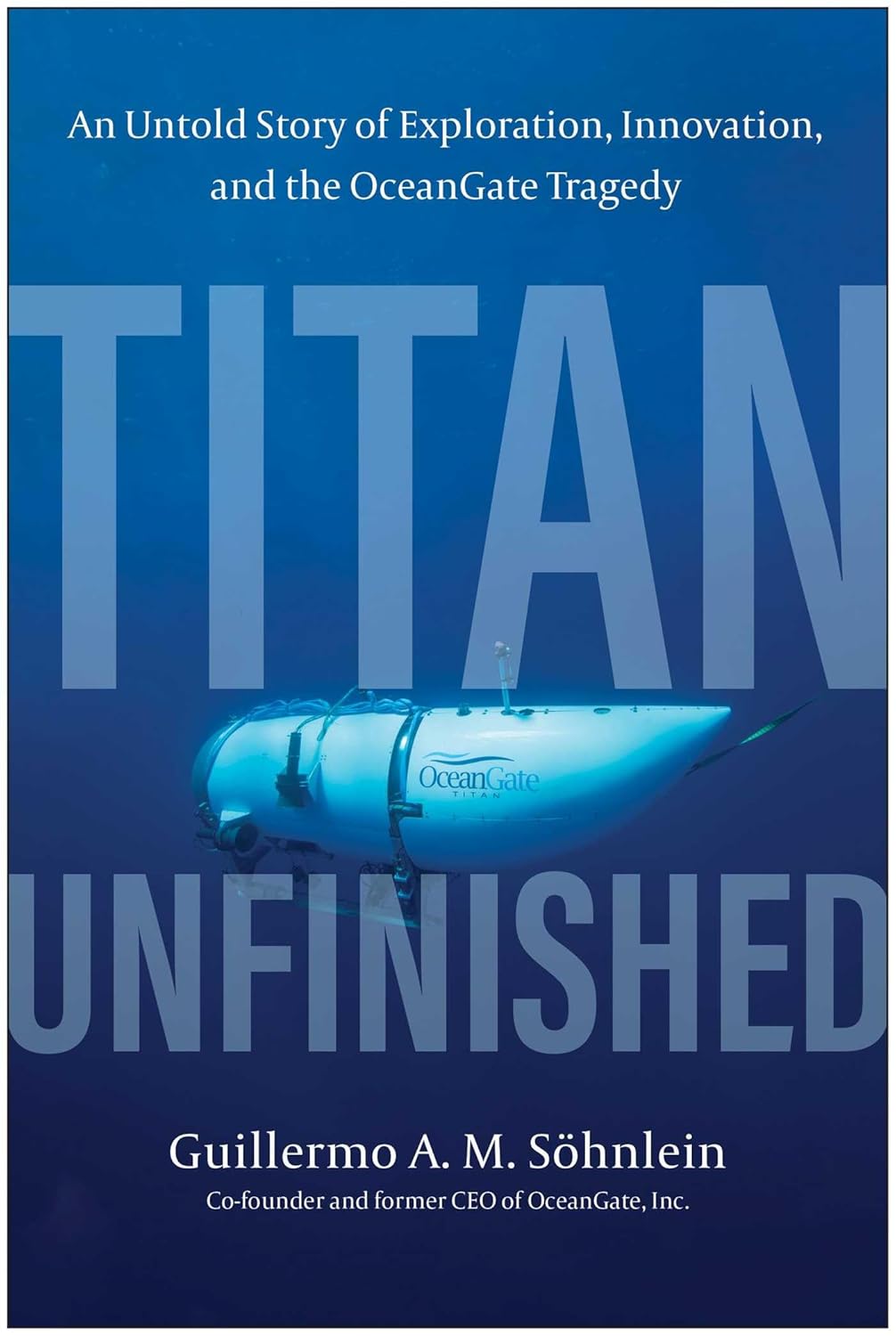
A firsthand, never-before-told account of the creation of OceanGate, the heartbreaking Titan tragedy and the supposed villain behind it all, Stockton Rush, as told by the only person who can: his co-founder and friend.
Titan Unfinished is more than a recounting of the events that led to the tragedy—it’s an up-close, personal account of Stockton’s journey, from the conception of OceanGate to his sudden death, told by one of the few people who was with Rush from the very start. Fellow co-founder Guillermo Sohnlein examines the full humanity of the man behind OceanGate’s ambitious mission and offers insights extending far beyond the attention-grabbing headlines, detailing Rush’s temperament, motivations, and tendencies, as well as the technology, operations, and key events at play in a story that has thus far been massively oversimplified.
What Guillermo Söhnlein says about the book:
“My primary motivation for writing this book is to ensure that anyone who forms an opinion regarding these events does so with a proper factual foundation and adequate context. I do not intend to defend Stockton as a flawless individual, OceanGate as a perfect venture, or Titan as an ideal of technology innovation, because they were none of these. However, I also know from personal experience that the media’s characterizations of Stockton, OceanGate, and Titan are nowhere close to being accurate. The truth lies somewhere in the nuances between the two extremes, and this is where I hope to shine a brighter light.”
Titan Unfinished for Educators & Students
“On 18 June 2023, five brave explorers lost their lives. Academic classrooms are the ideal settings for examining every aspect of this tragedy, discovering lessons to be learned, and helping humanity forge a path forward.”
ACADEMIC STUDY OF THE TITAN TRAGEDY
The story of the Titan implosion–along with the global media frenzy that surrounded it–lends itself to myriad discussion topics and lines of academic inquiry. Creative educators can incorporate this tragedy into a variety of courses with an abundance of supplemental reading materials, including our book.
We are fully committed to ensuring that a generation of students benefits from this incident as a platform for honing their individual and team critical thinking skills. We hope that the information below helps you plan your curriculum, but please reach out if there is anything else we can do to support your efforts.
We look forward to hearing from you!
Support from the Author
Book copies
- For educators – complimentary
- For students – discounted
Guest lectures
- Virtual – complimentary
- In-person – honorarium
Sample Courses & Topics
Titan Unfinished provides a compelling case study in the challenges of managing a startup through multiple phases of growth and strategic pivots. Students can examine the succession planning between co-founders, the transition from operations-focused leadership to engineering-focused leadership, and the complexities of managing distributed teams across different geographic locations. The book offers rich material for analyzing decision-making under resource constraints, managing stakeholder expectations, and balancing long-term vision with short-term operational realities in a highly specialized niche market.
Discussion Topics:
- Evaluate the effectiveness of OceanGate’s phased strategic approach and succession planning between co-founders
- Analyze the challenges of managing the tension between innovation goals and financial sustainability
- Discuss how the “no assholes” policy and other cultural elements influenced organizational effectiveness
- Examine the risks and benefits of splitting operational and engineering teams geographically during critical growth phases
- Assess the role of founder personality and management style in shaping organizational outcomes
The book illuminates critical governance questions about board composition, fiduciary duties, and the balance between supporting entrepreneurial risk-taking and ensuring adequate oversight. Students can examine how OceanGate’s board evolved over time, the role of investors versus founders in strategic decisions, and the challenges of governance in highly technical fields where board members may lack domain expertise. The narrative raises important questions about when and how boards should intervene in technical decisions, the responsibilities of directors when concerns are raised, and the governance implications of operating in largely unregulated spaces.
Discussion Topics:
- Analyze the board’s role and responsibilities in overseeing technical innovation decisions with safety implications
- Evaluate the decisions to add each OceanGate board member and the strategic considerations behind board composition
- Discuss the governance challenges when a company operates in a regulatory gray area with limited industry standards
- Examine the balance between supporting founder autonomy and exercising appropriate oversight in high-risk ventures
- Assess whether governance structures could have prevented or mitigated the eventual tragedy
Titan Unfinished offers an extraordinary real-time account of crisis communications during a global media event, including the author’s controversial decision to speak publicly against professional advice. Students can analyze the consequences of OceanGate’s silence during the search and rescue operation, the challenges of controlling narratives in the age of social media, and the personal and professional costs of crisis response decisions. The book demonstrates how the absence of a communication strategy can create a vacuum filled by speculation and criticism, and how difficult it is to shift public narratives once they solidify.
Discussion Topics:
- Evaluate OceanGate’s decision to remain silent during the search and rescue operation and its impact on public perception
- Analyze the author’s decision to speak to media against advice and assess the outcomes of that choice
- Discuss the role of social media trolls versus legitimate journalism in shaping crisis narratives
- Examine strategies for correcting misinformation when public opinion has already solidified
- Assess the long-term reputational consequences of crisis communication decisions for individuals and organizations
The book provides an intimate look at the entrepreneurial journey from initial whiteboard sessions to building a company that challenged industry norms. Students can examine the process of identifying market gaps, developing innovative business models, and the challenges of introducing disruptive technology in conservative industries. The narrative illustrates the tension between innovation and established standards, the difficulty of educating markets about new approaches, and the personal sacrifices required of entrepreneurs pursuing ambitious visions. It also raises important questions about when persistence becomes stubbornness and how to balance vision with feedback from domain experts.
Discussion Topics:
- Analyze OceanGate’s use of the Technology Adoption Curve framework to develop their go-to-market strategy
- Evaluate the “parallel path” approach to managing technology risk during the development of carbon fiber submersibles
- Discuss the challenges of innovating in industries with entrenched incumbents and established “best practices”
- Examine the role of personality and interpersonal dynamics between co-founders in startup success or failure
- Assess the entrepreneurial decision-making process when expert opinion conflicts with founder conviction
Titan Unfinished provides valuable insights into the intersection of commercial enterprise and scientific exploration, demonstrating both the potential and pitfalls of this relationship. Students can examine how OceanGate attempted to democratize access to deep-sea research, the Mission Specialist model for funding expeditions, and the practical challenges of conducting meaningful science in extreme environments. The book illustrates the critical role of subject-matter experts in exploration missions, the infrastructure required to support deep-sea research, and the broader question of how humanity can sustainably expand our understanding of Earth’s oceans.
Discussion Topics:
- Evaluate the Mission Specialist model as a funding mechanism for scientific research and exploration
- Discuss the balance between commercial tourism and legitimate scientific objectives in exploration ventures
- Analyze the role of technological innovation in expanding access to previously unreachable research environments
- Examine the ethical considerations of risk in scientific exploration and who should bear those risks
- Assess the long-term impact of the Titan tragedy on deep-sea exploration and research funding
The book contributes to the historical record of exploration disasters by providing an insider’s perspective often missing from official investigations and media accounts. Students can examine how the narrative of tragedy gets constructed in real-time, the role of speculation versus evidence in shaping public understanding, and how individual lives and motivations get reduced to simplistic characterizations. The account demonstrates parallels with other exploration disasters (Challenger, Columbia, early aviation accidents) and raises questions about how societies process risk, failure, and loss in the pursuit of advancement. It also illustrates the human tendency toward schadenfreude and the special fascination with tragedies involving the wealthy.
Discussion Topics:
- Compare the media coverage and public reaction to the Titan tragedy with other exploration disasters throughout history
- Analyze how the narrative of “villain” versus “hero” gets constructed in the immediate aftermath of tragedy
- Discuss the role of wealth and privilege in shaping public sympathy and media coverage of disasters
- Examine the difference between immediate media narratives and longer-term historical assessments of controversial figures
- Assess how tragedies influence regulatory frameworks and industry practices in exploration fields
Titan Unfinished offers a fascinating examination of operating in regulatory gray areas and the challenges of applying existing frameworks to novel technologies. Students can analyze the complexities of maritime law, the role of classification societies, the limitations of Coast Guard regulations designed for different types of vessels, and the question of whether and how to regulate experimental technologies. The book raises important questions about the balance between innovation and safety, the appropriate role of government oversight in high-risk activities, and whether current regulatory frameworks adequately address emerging technologies in exploration fields.
Discussion Topics:
- Evaluate the adequacy of existing maritime regulations for novel submersible designs and operations
- Analyze the role and limitations of classification societies (ABS, Lloyd’s) in ensuring safety versus stifling innovation
- Discuss the legal and ethical questions around informed consent for participants in experimental exploration ventures
- Examine the Coast Guard’s regulatory approach to submersibles and whether different frameworks would be more effective
- Assess the balance between individual freedom to take risks and society’s interest in public safety and resource allocation for rescues
Engineering Ethics: Students can examine the ethical responsibilities of engineers, the tension between innovation and established practices, peer review processes, and professional obligations when safety concerns arise.
Media Studies & Journalism: The book offers insights into modern journalism practices, the economics of media coverage, the impact of social media on information dissemination, and the challenges of reporting on complex technical subjects.
Organizational Psychology & Leadership: The book provides rich material for examining leadership styles, the psychology of risk-taking, organizational culture formation, and the impact of founder personalities on organizational outcomes.
Philosophy of Risk: The narrative raises profound questions about acceptable risk in exploration, who has the right to take risks, the value society places on different types of human life, and the philosophical basis for human exploration impulses.
Technology Adoption & Disruption: Students can examine how new technologies gain acceptance, the resistance established industries show to innovation, and the process by which experimental approaches become standard practices.